Community volunteers sought to take part in an archaeological excavation in Sligo Town in June 2026.
The Green Fort Archaeological Project
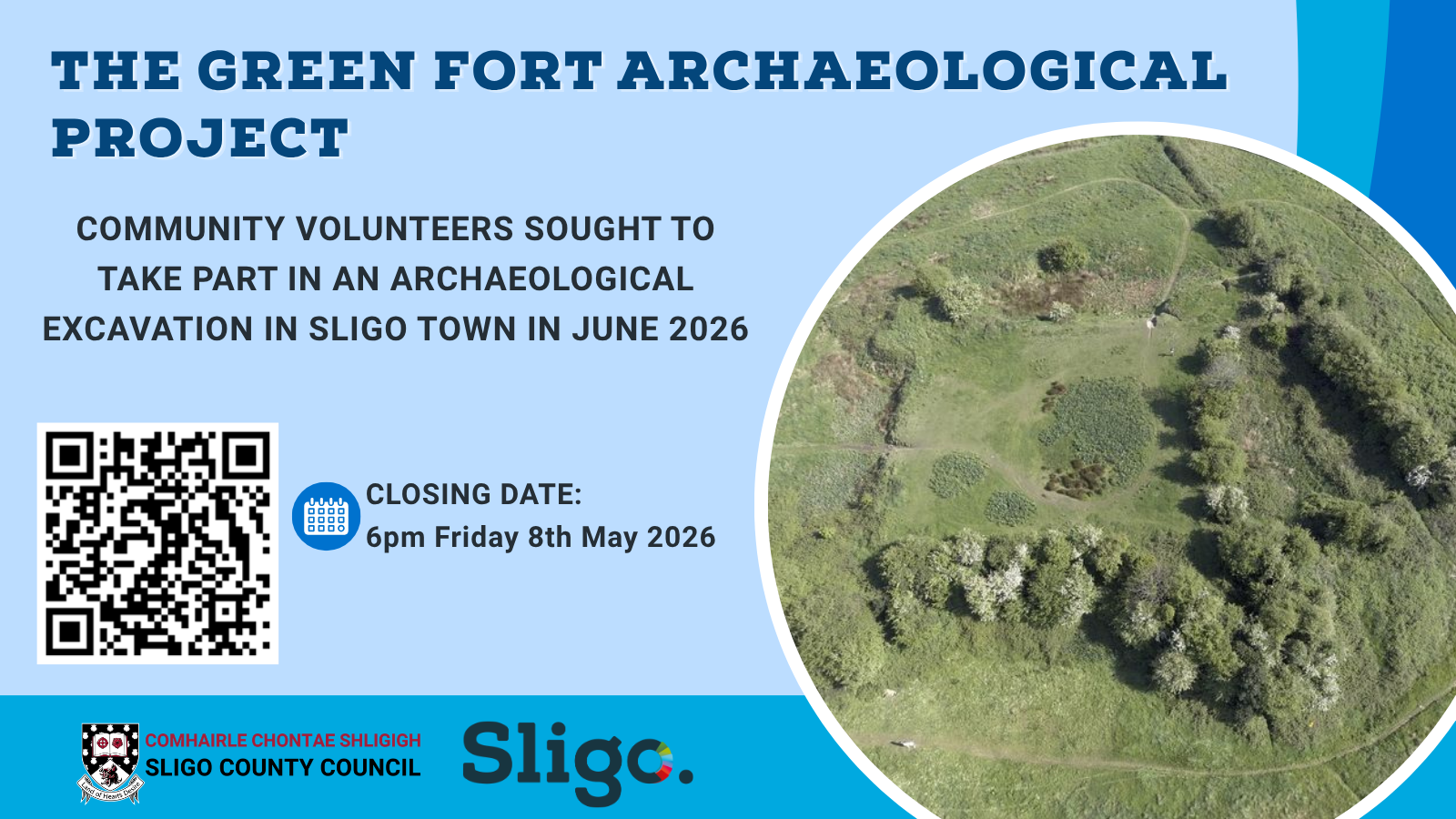
The Green Fort Archaeology Project was conceived in 2023 following discussions between ATU archaeologists Dr Fiona Beglane and Dr Marion Dowd, Sligo County Council, and the National Monuments Service. The focus of the project is to carry out archaeological excavations at the 17th century bastioned fort known as the ‘Green Fort’, which is located on Fort Hill, in Rathquarter townland in Sligo town. This is one of 65 bastioned forts in Ireland and one of seven such sites in Co. Sligo.
The Green Fort as it exists today was probably constructed during the Nine Years War (1594-1603). It became a strategic base during the Williamite Wars when it formed part of the defences of Sligo town. In 1689, the Jacobites were forced to abandon the Green Fort when the Williamites descended on Sligo with a party of 20,000 men. In October that year, under orders from James II, Sarsfield attacked the town and regained control. Colonel Henry Luttrell refortified the Green Fort and added additional outworks and defences. In June 1690, Sir Teige O’Regan was appointed commander of the Jacobite forces in Sligo and added further defences to the fort.
During the second siege of Sligo, in 1691, the Green Fort was attacked by Williamite forces. At this time, the fort had 16 cannons mounted on the defences and 30 barrels of gunpowder in the magazines. The garrison included officers, soldiers, gunners, gunsmiths, bakers and chaplains. The Green Fort was abandoned relatively soon after the Williamite Wars and was in a ruinous state by 1739.
The 2025 archaeological excavations
The first ever archaeological excavation of the Green Fort itself took place over two weeks in June 2025, directed by Dr Fiona Beglane and Dr Marion Dowd, ATU and with the co-operation and support of Sligo County Council and the Forthill Men’s Group.
The 2025 excavation was a great success. A layer of demolition debris was discovered spread across the interior of the fort, probably to provide a level surface for later activities. This layer contained significant quantities of brick, slate, possible floor tile, glass, pottery, clay pipes, and military finds such as musket balls and a possible gunflint. The lack of 20th and 21st century finds, and the presence of the military artefacts, suggest that this layer was laid down in historic times. It may be associated with preparation of the fort for the defence of Sligo against Humbert’s forces in 1798 when Captain William Smith of the Loyal Essex Fencible Infantry is recorded as having levelled the fort to mount artillery guns facing the principal approach roads to Sligo. Two large areas of burning were discovered which may be the bases of kilns, or the locations of intense bonfires. A stone-built drain was exposed which demonstrates efforts to improve the living conditions for soldiers stationed in the fort.
The Green Fort Archaeology Project was designed as a training excavation with an additional focus on community outreach. In 2025, 14 ATU students took part, hailing from Ireland, Ukraine, Belgium, Germany, Kosovo, US, Canada and Australia. Eleven community volunteers also participated for blocks of two or three days each, undertaking the same tasks as the students both on-site and in the post-excavation laboratory. A public open day and visits by several schools took place, providing an opportunity for over 150 people to see the excavation taking place. There was also intense media interest, with the excavation featuring on RTÉ Six-One news, as well as RTÉ radio, Ocean FM radio and in the Sligo Weekender and Sligo Champion.
Green Fort Archaeological Project 2026
A second season of archaeological excavations will take place at the Green Fort in June 2026. This year we hope to gain further insight into the nature of the buildings, structures and features that once occupied the fort, thus shedding light on the lives of those stationed there during the 17th century. Community participation and engagement will be a key component of the Green Fort Archaeology Project, through outreach events as well as community participation in the excavations.
The Green Fort Archaeology Project will involve three weeks of excavation and post-excavation work, on-site and in the Archaeology Laboratory at ATU Sligo, from 1–19 June 2026. The excavation will be directed by Dr. Fiona Beglane (licence holder) and Dr. Marion Dowd.
We are now seeking 12 community volunteers for two and three day sessions funded by Sligo County Council! If you are interested in being part of the Green Fort Archaeology Project, please visit the link below or write to: Marion Dowd, Faculty of Science, ATU Sligo.
The closing date for completed Green Fort Excavation - Volunteer Application Forms is 6pm Friday 8th May 2026.
Link to Application Form - https://forms.gle/SMfyfsiH4SuResTz6